Stablecoin Sandwich: Definition and key benefits in cross-border payments
Understand how the stablecoin sandwich integrates fiat currencies and enables faster, lower-cost cross-border payments.

Conduit
January 13, 2026
Discussions around stablecoins are relatively recent and have been gaining broad attention in media publications and in conversations about finance around the world, due to their clear potential to move money from one country to another with nearly the same speed and convenience as sending a simple email. When fiat currencies and stablecoins coexist within the same financial flow, this process is referred to as a stablecoin sandwich.
The term stablecoin sandwich has been becoming increasingly popular in the industry, but it is important to understand in depth what it is and its purpose within the context of international payments. In this article, we will cover:
- What Is a Stablecoin Sandwich
- How a Stablecoin Sandwich Works
- Benefits of a Stablecoin Sandwich
- Use Cases of a Stablecoin Sandwich
What is a Stablecoin Sandwich?
A stablecoin sandwich is a cross-border payment strategy that uses stablecoins as intermediate layers to move funds across different fiat currencies, such as the U.S. dollar, euro, British pound, among others.
The sandwich analogy comes from the structure of this transaction, which begins and ends in fiat currency, briefly passing through stablecoins in the middle of the flow and within the blockchain system.
Typically, the stablecoins used in this process are backed by fiat currencies, with their value pegged 1:1 to a traditional currency, such as the U.S. dollar or the euro.
It is important to note that neither the sender nor the beneficiary interacts with this crypto layer, as it serves solely as processing infrastructure. Their experience takes place entirely in traditional currencies, both when sending and receiving funds, as in a standard payment.
How a Stablecoin Sandwich works
Now let’s take a closer look at how a stablecoin sandwich works, with funds moving from one country to another using this infrastructure. Let’s assume we want to pay an invoice of USD $1,000 from Brazil to a supplier’s account in the United States.
Step 1 - Conversion from local fiat currency to stablecoin
The transaction begins in the payer’s local fiat currency, in this example, Brazilian reais. The invoice amount in reais, based on the exchange rate of the day, is converted into fiat-backed stablecoins, typically pegged to the U.S. dollar. Since the stablecoin maintains a 1:1 parity with the dollar, the resulting amount will be equivalent to USD $1,000.
This conversion from fiat currency to stablecoin is known as an on-ramp and is processed by payment platforms such as Conduit, which has direct connections with banks and payment networks to move funds locally. In addition, Conduit conducts the full KYB and KYC process for all parties involved in the transaction to ensure full compliance.
Step 2 - Stablecoin crosses borders on a blockchain
Once the funds have been converted into stablecoins, they move from one country to another within a blockchain network. This process typically takes only a few minutes and offers full traceability and transparency, which are core characteristics of blockchain systems that create an immutable, encrypted, and auditable transaction record.
Step 3 - Conversion from stablecoin to the destination fiat currency
To reach the final destination account, the funds must be converted into the beneficiary’s fiat currency, which in this example is U.S. dollars. In this stage, known as the off-ramp, the funds are converted from stablecoins into USD and delivered to the destination account through connections with local payment networks, such as Fedwire or ACH.
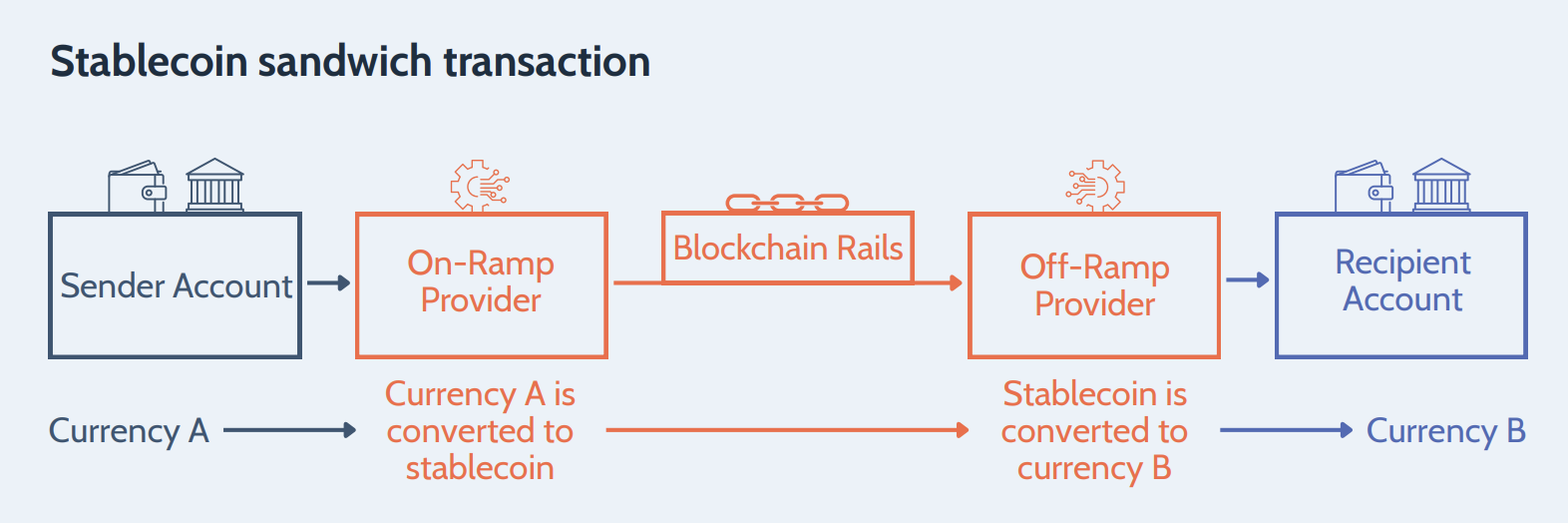
It is worth noting that, in some cases, the final conversion may take place at a later time, as the beneficiary may choose to temporarily hold the funds in stablecoins, either in an account or a wallet, and convert them into their local currency at a more opportune moment. This scenario is referred to as a half stablecoin sandwich, since the final conversion may be optional in certain use cases.
Benefits of the Stablecoin Sandwich
Elimination of a fragmented network of intermediaries
Stablecoin infrastructure eliminates the fragmentation of legacy systems, in which a payment passes through multiple intermediaries and correspondent banks before reaching its final destination. With stablecoins, funds follow a more direct and faster flow and connect directly to local instant payment networks.
Lower costs and faster processing times
In legacy systems, each intermediary and bank has its own processing timelines and fees, making settlement times and final amounts unpredictable for both senders and beneficiaries. This creates direct impacts on corporate liquidity. With the stablecoin sandwich, payment processing is reduced from days to minutes, at a fraction of the cost of legacy systems, without hidden fees, providing greater predictability for cross-border operations.
Parity with fiat currency
The stablecoins used in a stablecoin sandwich are typically backed 1:1 by fiat currencies such as the U.S. dollar or the euro, ensuring value preservation throughout the entire transaction. This parity significantly reduces exposure to FX risk and allows companies to operate internationally with greater control over the volatility commonly associated with local currencies or non-stable assets.
Traceability and Control
Because they operate on blockchain infrastructure, stablecoin transactions offer end-to-end traceability. Every movement can be monitored in real time, from origination to final settlement, facilitating reconciliation, auditing, and financial management processes. This provides greater operational control and reduces inefficiencies common in legacy systems, where payments often “disappear” among intermediaries.
Security and Compliance
The stablecoin sandwich can operate within robust regulatory frameworks, incorporating KYC, AML, governance, and fund segregation practices aligned with the traditional financial system. This reduces operational risk and strengthens trust among companies, financial institutions, and regulators.
Interoperability with real-time payment networks
One of the main differentiators of this model is its ability to connect directly with local instant payment networks such as Pix, Fedwire, SEPA, FPS, or SPEI. Stablecoins act as an interoperability layer, enabling isolated domestic systems to communicate efficiently with one another and making international payments as seamless as local ones.
Greater Scalability
By eliminating dependence on correspondent banks, banking hours, and pre-funded liquidity across multiple currencies, the stablecoin sandwich enables financial operations to scale globally with less complexity. It supports increasing transaction volumes without a proportional rise in costs or operational friction.
Use Cases of the Stablecoin Sandwich
Vendor Payments
In the context of international supplier payments, the stablecoin sandwich enables faster and more predictable settlements. This reduces operational costs, improves the ability to purchase goods and services, and strengthens supplier relationships.
Remittances
For international remittances, the model enables faster and more transparent transfers, with continuous settlement and greater traceability throughout the entire payment flow.
Global Treasury Management
In global treasury management, the stablecoin sandwich facilitates liquidity centralization, cash balancing across countries, and reduces the complexity associated with maintaining multiple bank accounts.
Global Payroll
For global payroll operations, the model provides greater predictability and efficiency in transferring funds to employees and contractors across different markets.
Fintechs, PSPs, and Neobanks
For fintechs, payment service providers, and neobanks, the stablecoin sandwich acts as an interoperability layer that enables scalable cross-border products, integration with local payment rails, and improved operational efficiency.
Conduit helps businesses scale payments with greater agility and lower costs
Conduit’s solutions help companies simplify and scale their international financial operations. Through the stablecoin sandwich infrastructure, funds can be moved across countries with significantly greater efficiency, predictability, and security.
While businesses operate using familiar fiat currencies and local payment rails, Conduit’s stablecoin infrastructure manages the natively digital layers, seamlessly handling on-ramp and off-ramp flows between local and global payment systems.
The result is a smoother, more controlled cross-border payments experience that is built for scale. Elevate your international B2B operations today.


.jpg)





.jpeg)